


Table of Contents
Table of Contents
Where should a China-sourced brand keep inventory for Canadian customers?
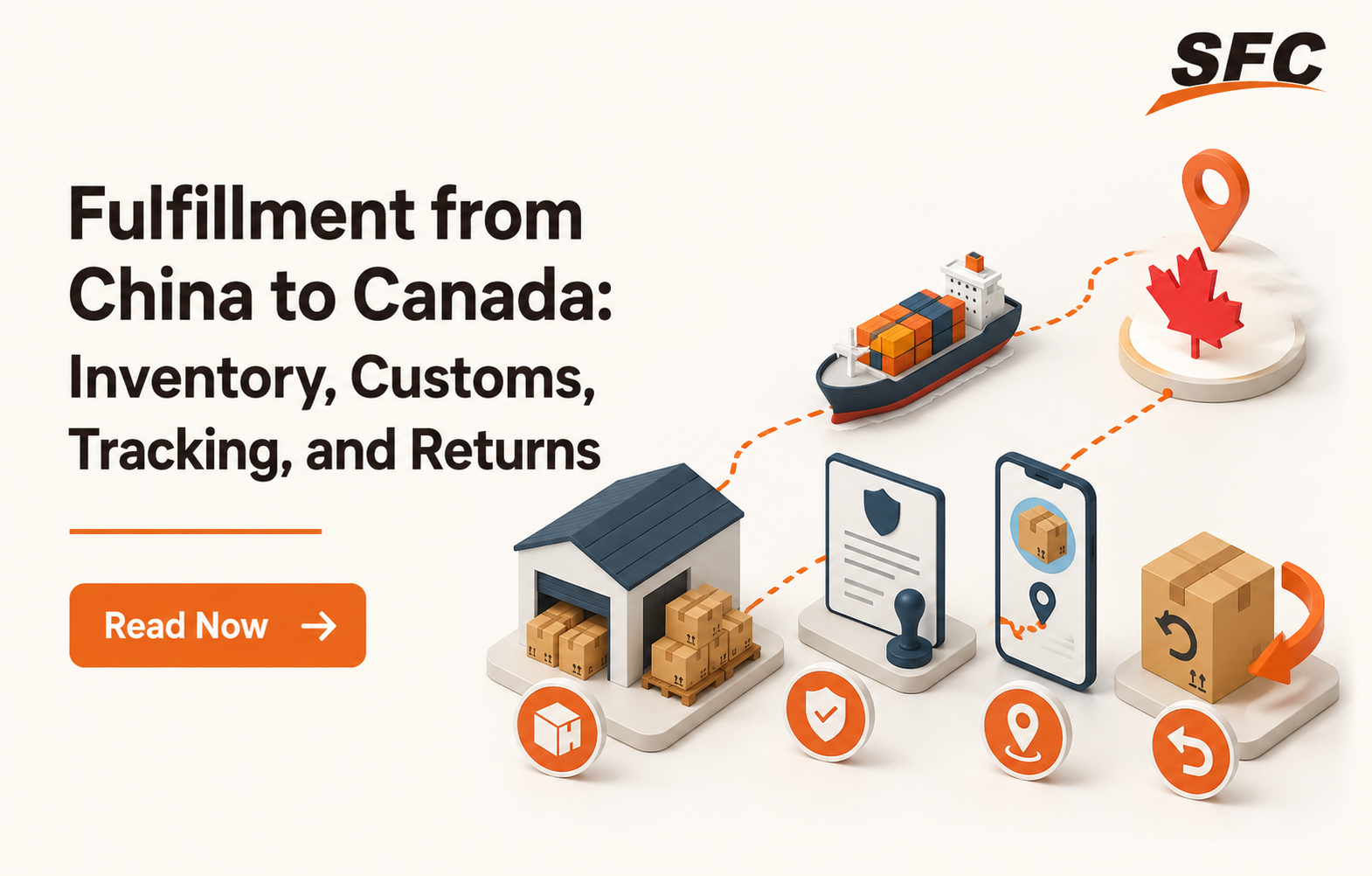


Beside the factory in China? Inside a Canadian fulfillment center? Or split between both?
That choice looks like a shipping question. It is really an inventory, customs, delivery, and returns question all tangled together. A Canadian warehouse may give customers faster domestic delivery. It can also leave you paying storage for the wrong sizes and colors. Direct fulfillment from China keeps stock close to suppliers. Yet every order has to cross the border, and returns need more thought.
Here is the short version. Direct China fulfillment fits brands with uncertain Canadian demand, many long-tail SKUs, or customers spread across several countries. Canadian fulfillment fits steady local volume, predictable best sellers, tight delivery promises, and products with frequent returns. A hybrid model puts proven Canadian sellers locally and keeps slower or experimental items in China.
There is no magic warehouse location. The right setup depends on demand, margin, product restrictions, customs ownership, delivery expectations, and return cost. Let's sort it out.
Scope note: This article provides operational information, not legal or tax advice. Canadian customs and tax treatment depends on the goods, transaction, shipment method, seller structure, and importer. Confirm your setup with a licensed Canadian customs broker and qualified tax adviser before launch.
What Does China-to-Canada Ecommerce Fulfillment Include?
Fulfillment starts before a Canadian buyer orders. Products move from suppliers into a warehouse for receiving, counting, SKU recording, inspection, and storage. Orders then trigger picking, packing, customs data, route selection, tracking, delivery, and after-sales work.
A complete process may include:
- supplier receiving, SKU control, and storage;
- store or marketplace order sync;
- address validation, pick and pack, inserts, and labels;
- customs descriptions, HS codes, origin, and values;
- route selection, tracking, and delivery exceptions;
- returns, inspection, restocking, disposal, or replacement.
This differs from factory shipping and pure dropshipping. A fulfillment warehouse manages seller-controlled inventory, repeat orders, variant accuracy, packing rules, carriers, tracking, and returns.
An ecommerce fulfillment operation in China connects those steps in one workflow, from supplier receiving to tracking updates.
Direct from China, a Canadian Warehouse, or a Hybrid Model?
The best model is the one that matches current Canadian demand, not the one that sounds most established.
Direct Cross-Border Fulfillment from a China Warehouse
In this model, inventory stays in China. Each Canadian order is picked, packed, and shipped as an international parcel.
It works well when products are made in China and sold to several countries. One stock pool avoids splitting inventory too early. New products can launch without waiting for a bulk Canadian import, and slow variants do not sit in a distant warehouse. Supplier updates also reach the fulfillment center quickly.
The tradeoff is distance. Delivery takes longer than domestic Canadian shipping. Every parcel needs usable customs data. A customer may face charges if the tax and duty model is not clear. Physical returns to China can also cost more than the item is worth.
Bulk Inventory Imported into a Canadian 3PL
Here, the brand sends cartons, pallets, or containers from China to Canada. A Canadian warehouse receives the goods and ships domestic orders.
This shortens the customer-facing delivery window and makes local returns easier. It suits stable best sellers and repeat-purchase products. But inventory moves before the customer buys, so a weak forecast can create Canadian stockouts or months of slow storage.
The bulk shipment is also a commercial import. Importer setup, CARM, customs accounting, duties, taxes, brokerage, and warehouse receiving need to be planned before the goods leave China.
Hybrid Inventory Placement
A hybrid model keeps proven Canadian sellers in Canada and leaves long-tail, custom, or experimental products in China. Two pools need clean routing, stockout, and split-shipment rules.
Still, hybrid fulfillment often gives a growing brand the best balance. It buys domestic speed where demand is real without betting the whole catalog on one market.
|
Fulfillment model
|
Best fit
|
Inventory risk
|
Customs model
|
Delivery and returns
|
Main cost exposure
|
|
Direct from China
|
Uncertain Canadian demand, global sales, long-tail SKUs, frequent product changes
|
Lower risk of stock stranded in Canada
|
Parcel-level cross-border clearance
|
International delivery; local return partner or case-by-case return rules
|
International parcel freight, customs friction, replacements
|
|
Canadian warehouse
|
Stable local volume, predictable best sellers, strict delivery targets, frequent returns
|
Higher forecast and storage risk
|
Bulk commercial import, then domestic orders
|
Faster domestic delivery and simpler local returns
|
Inbound freight, duty/tax cash flow, receiving, storage, domestic shipping
|
|
Hybrid
|
Growing Canadian demand with a mix of fast and slow SKUs
|
Moderate, but needs accurate allocation
|
Bulk imports for local SKUs plus parcel clearance for China stock
|
Domestic service for core items; cross-border service for long-tail orders
|
Two-location systems, stock balancing, possible split shipments
|
Plan Canadian Inventory Without Overcommitting
Do not use worldwide sales as a stand-in for Canadian demand. A product that sells well in California may move slowly in Alberta. Build a Canada-specific view by SKU.
Track Canadian orders by SKU, province, season, margin, return rate, replenishment lead time, product life, stockout cost, and storage exposure.
Start with a small group of stable SKUs. Moving the full catalog on day one is like packing every coat for a weekend trip. Mostly, it creates baggage.
Reorder Points Need the Full Replenishment Cycle
A Canadian reorder point must cover production, China receiving, export booking, transport, customs, Canadian receiving, and put-away. Use a realistic slow-case lead time, not only an average.
Direct China fulfillment reduces country-level stock splitting, though inventory must still cover supplier delays, quality holds, and demand spikes.
Packaging Changes Both Cost and Condition
Final packed dimensions matter. Carriers may charge the greater of actual and dimensional weight. Bulk freight also responds to volume. A gift box that adds two centimetres on every side can create a surprisingly large annual cost.
Match materials to the product: poly mailers for suitable soft goods, cartons and inserts for crush or impact protection, void fill to prevent movement, moisture protection where needed, and scannable labels.
Canadian labeling varies by category. Textiles, food, cosmetics, toys, wireless devices, and regulated goods may face different requirements. Customs release does not prove a product is legal to sell.
SFC's China order fulfillment service covers receiving, SKU control, packing instructions, dispatch, tracking, and returns within one operational process.
Canada Customs Rules for Ecommerce Orders Shipped from China
This is where several innocent-looking numbers cause a lot of confusion.
Do Not Apply the US and Mexico CUSMA Thresholds to Direct China Shipments
The current CBSA low-value shipment guidance says:
- mail imported from any country is duty and tax free at CAD 20 or less, subject to exclusions;
- courier shipments imported from countries other than the US and Mexico are duty and tax free at CAD 20 or less, subject to exclusions;
- above CAD 20, duties and taxes apply to courier shipments from countries other than the US and Mexico;
- the higher CAD 40 tax and CAD 150 duty thresholds listed on the page relate to qualifying courier imports from the US and Mexico.
So, a parcel shipped directly from China does not become duty free simply because its value is below CAD 150. Country of manufacture and country of shipment are also different concepts. Do not guess at preferential treatment from a supplier's routing description.
Some goods are excluded. Alcohol, tobacco, cannabis products, and other categories can face separate treatment.
Another number appears in Canadian guidance: CAD 3,300. This is a low-value commercial shipment threshold used for simplified release and accounting processes. It is not a blanket duty- and tax-free allowance. Mixing CAD 20 and CAD 3,300 is like confusing a shorter checkout queue with a free shopping basket. One changes procedure. The other changes whether charges may be remitted.
Decide Who Is the Importer of Record
The importer of record is responsible for the declaration and related obligations. It may be a Canadian business, seller, customer, marketplace, or another properly arranged party. "The carrier handles it" is not a complete importer plan.
For direct consumer parcels, the customer may be treated as importer and asked to pay charges on delivery under a DAP-style setup. Under a properly arranged DDP model, the seller takes responsibility for agreed import costs and gives the customer a cleaner landed-price experience.
Commercial Imports, CARM, and Broker Access
When inventory enters Canada for storage and later sale, the importer needs a commercial import process. The CBSA CARM service is the official system used to assess and collect duties and taxes on commercial goods.
Depending on the structure, preparation may include a Canadian business number, RM account, CARM registration, broker delegation, payment arrangements, financial security where relevant, and supporting records.
A broker can submit entries, but the importer should know who owns the account, pays CBSA, and keeps records. Broker access does not remove importer responsibility.
Prepare Customs Data Before the Order Arrives
Good customs data starts at SKU setup, not after a parcel is held.
For each SKU, maintain a specific description, HS code, origin, value, currency, quantity, material or use where relevant, party information, and required permits or reports.
"Accessory," "gift," and "sample" are weak descriptions. "Polyester women's running shorts" is useful. Values must follow applicable rules; unrealistic declarations can lead to reassessment, penalties, or seizure.
DDP Versus DAP for Canadian Buyers
Under DAP, the seller pays to deliver the parcel to the named place, while the buyer generally handles import charges and clearance obligations assigned to them. Under DDP, the seller accepts broader responsibility, including import duties and taxes, subject to a compliant structure.
The buyer's question is simple: "Will I pay more before delivery?" Unexpected duty, tax, brokerage, or carrier fees can cause refusals. Separate government charges from broker or carrier fees.
The broader guide to DDP shipping from China explains how seller, carrier, broker, and importer responsibilities fit together.
|
Customs issue
|
Direct B2C parcel question
|
Bulk inventory question
|
Evidence to retain
|
|
Importer
|
Is the customer, seller, marketplace, or another party the importer?
|
Which Canadian entity imports warehouse stock?
|
Contract, power of attorney, account details
|
|
Classification
|
Which HS code and duty treatment apply to the SKU?
|
Are classifications consistent across the commercial shipment?
|
Product data, ruling or broker rationale where available
|
|
Valuation
|
What is the correct value for duty?
|
Which transaction and adjustments support the declared value?
|
Commercial invoices, purchase records, freight data
|
|
Taxes and fees
|
Will the buyer pay duty, tax, brokerage, or handling at delivery?
|
How will duties and taxes be accounted for and funded?
|
Quote breakdown, customs statement, carrier invoice
|
|
Product controls
|
Does the parcel require permits, labels, or agency review?
|
Can the full commercial quantity be legally imported and sold?
|
Test reports, permits, labels, compliance files
|
|
Returns
|
What happens to refused or undeliverable parcels?
|
Can returned stock be re-entered, restocked, or claimed for relief?
|
Tracking, return reason, original entry and export records
|
Shipping Options from a China Fulfillment Center to Canada
The best route depends on the packed parcel, value, product eligibility, postcode, delivery promise, and customs model.
Postal Parcels
Postal services suit lightweight, lower-value, flexible orders and can help with PO boxes or broad reach. Tracking may pause before Canadian acceptance, while customs timing, delivery proof, and claims coverage can vary.
Dedicated Ecommerce Lines
A dedicated line consolidates Canadian orders in China, moves them through a planned line haul and customs gateway, then injects parcels into Canada Post or a commercial last-mile carrier.
This is often the middle ground between postal and express. It works best with regular Canadian departures, stable clearance, and a capable last-mile partner.
Ask who handles customs, whether service is DDP or DAP, how often flights depart, whether the tracking number changes, which remote areas are excluded, and what happens to undeliverable parcels.
Express Courier
DHL Express, FedEx, and UPS suit urgent or high-value shipments and usually provide detailed scans. Check dimensional weight, fuel, remote areas, brokerage, duty advancement, corrections, and oversized handling.
Bulk Air or Ocean Replenishment
Air freight can move launch stock or rescue a Canadian stockout. Ocean freight usually suits stable volume with a longer planning horizon. Neither ends at the airport or port. Add export work, customs, drayage, Canadian receiving, inspection, and put-away before calling inventory available.
The ecommerce shipping services page provides the practical route categories SFC uses for international orders. For current options, packed dimensions should be checked through the shipping cost calculator.
Build Tracking Around Milestones, Not One Number
A tracking number is a key. It is not proof that the parcel has moved.
The customer timeline should show order confirmation, packing, carrier acceptance, export departure, Canada arrival, customs release, last-mile receipt, out-for-delivery, and delivery or pickup.
"Label created" only means shipment data exists. The first physical scan shows the carrier has the parcel. Measure the gap between these two events. A warehouse that prints labels on Monday but hands parcels over on Thursday is not offering Monday dispatch.
Tracking may pause during consolidation, international transport, customs, or data exchange. A dedicated line may also issue a second number for Canada Post or another final-mile carrier. The fulfillment system should map both numbers and upload useful events to the store.
Assign an owner and response time for each exception: missing first scan, customs request, incomplete address, failed delivery, pickup deadline, damage, loss, and return to sender. Customers care less about which partner caused the delay than who is going to fix it.
The guide on improving delivery speed from China explains how warehouse cutoff, dispatch frequency, customs data, and last-mile performance affect the full delivery time. Teams can also track an international parcel through SFC when reviewing live milestones.
Build a Canadian Returns Strategy Before Launch
Returns are not simply outbound shipping played backwards. The parcel may cross a border again, arrive without useful product data, or cost more to move than the item is worth.
Return Directly to China
An international return can make sense for high-value warranties, repairs, or supplier investigation. It is usually poor economics for low-value items. By then, the product has taken a rather expensive holiday.
Returns need authorization, order reference, reason code, declared information, and the correct address. Otherwise the warehouse receives a mystery parcel.
Use a Canadian Return Address
A local address gives buyers a domestic label and familiar drop-off. Goods can be inspected, restocked, refurbished, consolidated, donated, recycled, destroyed, or returned to China in batches.
The Canada Post ecommerce returns integration includes merchant return tools, APIs, labels, tracking data, and approved partner options. Availability and commercial terms depend on the merchant's setup.
A return address alone is not an operation. Someone must identify the item, assess condition, record evidence, and follow a disposition rule.
Refund or Replace Without a Return
For a low-value damaged item, a returnless refund or replacement may cost less than domestic return handling. Set thresholds by product value, reason, fraud risk, photo evidence, customer history, and whether the item can be safely kept or disposed of.
Do not improvise every case. A written rule makes support faster and produces cleaner return data.
|
Return situation
|
Likely path
|
Warehouse action
|
Inventory outcome
|
Main risk
|
|
Low-value unopened item
|
Canadian local return if economical, or customer keeps it
|
Verify seal and condition if returned
|
Restock, liquidate, or consolidate
|
Handling may exceed resale value
|
|
Damaged low-value item
|
Refund or replace without return
|
Review photos and record damage reason
|
Write off
|
Fraud or hidden packaging problem
|
|
Resellable apparel
|
Canadian return address
|
Inspect, grade, fold, and rebag
|
Restock locally if clean
|
Variant mismatch and cleaning cost
|
|
Defective electronics
|
Local triage or return to China
|
Record serial number, test, photograph
|
Repair, refurbish, parts recovery, or scrap
|
Battery safety and warranty evidence
|
|
High-value warranty item
|
Tracked local return, then specialist review
|
Secure receiving and documented inspection
|
Repair, replace, or return to supplier
|
Loss, data security, and customs records
|
|
Undeliverable parcel
|
Recover through last-mile process
|
Check address and packaging condition
|
Reship, restock, or dispose
|
Repeated address failure and carrier fees
|
Product and Industry Exceptions
Different categories can share a warehouse without sharing the same rules.
Apparel and Footwear
Use clear variant barcodes, garment protection, and packing checks. Local returns can recover resellable stock, but inspection, rebagging, and seasonal markdown still cost money.
Electronics and Battery Products
Battery acceptance depends on configuration, type, rating, tests, packaging, labels, and carrier rules. Record serial or batch data, and protect devices without creating excessive dimensional weight.
Cosmetics, Wellness, Food, and Regulated Goods
Health Canada, the Canadian Food Inspection Agency, other federal bodies, or provincial rules may apply. Ingredients, claims, bilingual labels, licences, notifications, or import controls may be relevant. Customs clearance is not market approval.
Crowdfunding, Toys, Pet Products, and Seasonal Goods
Crowdfunding adds mixed rewards and launch spikes. Toys may need safety and labeling work. Pet goods range from simple accessories to regulated items. Seasonal products can lose their selling window if a bulk shipment is late.
The route and inventory model should follow the exact product, not a broad category label.
Calculate the Real Fulfillment Cost
Compare cost per delivered order, not a single shipping rate.
Use this model:
total cost per delivered order = fulfillment + packaging + freight + customs and brokerage + expected delivery failure + support + returns
For Canadian warehouse stock, add bulk inbound freight, customs cash flow, receiving, storage, domestic pick and pack, local shipping, and stranded inventory. For China stock, include international parcel freight, customs friction, replacements, customer support, and the chosen local return solution.
If direct delivery costs CAD 3 less but creates more support and replacements, the cheaper label may not be the cheaper model. Canadian stock costs more to hold, yet can recover resellable returns and improve delivery.
Use one order profile when comparing providers: same SKU, packed dimensions, monthly volume, province mix, service level, customs term, and return assumptions. The guide on comparing China fulfillment quotes provides a line-by-line method for finding excluded costs.
Run a Canadian Pilot Before Moving More Inventory
Test real postcodes. Include Toronto, Vancouver, Montreal, Calgary, smaller cities, apartments, and remote regions relevant to your customers. Include PO boxes only on services that support them.
Track warehouse processing, first carrier scan, median and P90 delivery, customs dwell, delivery within promise, first-attempt success, tracking completeness, support contacts, losses, returns, recovery value, and total cost per delivered order.
Do not judge only by an average. P90 exposes the slow tail that creates complaints.
Move a SKU into Canada when its local velocity is stable enough to support a replenishment cycle, its margin can absorb local storage and fulfillment, and faster delivery or local returns create measurable value. Set a review threshold. "It feels like we are big enough now" is not inventory planning.
Conclusion: Match the Fulfillment Model to Canadian Demand
Direct fulfillment from China protects inventory flexibility and keeps products close to suppliers. A Canadian warehouse can deliver core products faster and make local returns easier. Hybrid fulfillment combines both, but it needs clean routing and stock rules.
Start with demand and SKU behavior. Then decide who owns customs, which delivery promise is realistic, and how returns will work. Compare total cost only after those questions are answered.
For many growing brands, the sensible first step is direct China fulfillment with a tested Canadian parcel route and a local return solution. Move stable best sellers into Canada when the data supports it. Keep long-tail and launch inventory in China until demand earns a local shelf.
That approach is not flashy. It is simply harder to regret.
Frequently Asked Questions
1. How does fulfillment from China to Canada work?
Products move from suppliers to a China fulfillment center for receiving, storage, order sync, pick and pack, customs-data preparation, and international shipping. The parcel then clears Canadian customs and enters a postal or commercial last-mile network. Tracking, delivery exceptions, returns, and replacements complete the workflow.
2. How long does ecommerce shipping from China to Canada take?
It depends on the route, origin cutoff, product, customs, postcode, and season. Express is often measured in a few business days, dedicated lines commonly operate within a broader one-to-two-week style window, and postal services can vary more. These are planning ranges, not promises. Use live route estimates and lane data.
3. Are goods shipped directly from China to Canada duty free under CAD 150?
No, not as a general rule. The higher CUSMA courier thresholds shown by CBSA relate to qualifying shipments from the US and Mexico. Direct mail and courier shipments from China generally use the CAD 20 remission threshold, subject to exclusions and the specific transaction.
4. What is Canada's de minimis threshold for parcels from China?
CBSA states that mail from any country and courier shipments from countries other than the US and Mexico are duty and tax free at CAD 20 or less, subject to exclusions. The CAD 3,300 low-value commercial threshold concerns simplified release and accounting. It is not a tax-free allowance.
5. Is DDP shipping from China to Canada better than DAP?
DDP can create a smoother checkout and delivery experience because agreed import costs are handled by the seller. It also requires a compliant importer, customs, and tax setup. DAP may be simpler for the seller but can surprise the buyer with charges. Better depends on order value, margin, structure, and customer promise.
6. Does an ecommerce seller need a CARM account to import inventory into Canada?
A business importing commercial inventory into Canada may need a business number, RM account, CARM registration, broker delegation, and related accounting arrangements. The exact setup depends on who is importer of record and how goods enter Canada. Confirm it with CBSA guidance and a licensed customs broker.
7. Should I store inventory in China or use a Canadian fulfillment center?
Keep inventory in China when Canadian demand is uncertain, the catalog has many slow SKUs, or one stock pool serves several countries. Use Canadian fulfillment for stable volume, predictable best sellers, tighter domestic delivery, or frequent returns. A hybrid model often suits a growing brand.
8. Why does China-to-Canada tracking stop updating after departure?
The parcel may be in consolidated line haul, awaiting customs, or moving between data systems. A Canadian last-mile carrier may issue a second tracking number. The provider should map both numbers and distinguish label creation, physical acceptance, customs release, and final-mile events.
9. How should a China-based brand handle customer returns in Canada?
Use a Canadian return address for products that can be restocked or consolidated. Send high-value warranty items to an appropriate inspection point. For low-value damage claims, a refund or replacement without return may cost less. Set rules by value, condition, reason, fraud risk, and recovery value.
10. Can batteries, cosmetics, and regulated products ship from China to Canada?
Possibly, but acceptance and sale requirements depend on the exact product. Batteries may need compliant tests, packaging, labels, and an approved route. Cosmetics, food, wellness products, toys, and other regulated goods may need Canadian licences, notifications, labels, or documents. Customs clearance alone is not product approval.
 Want to know about our services, fees or receive a custom quote?